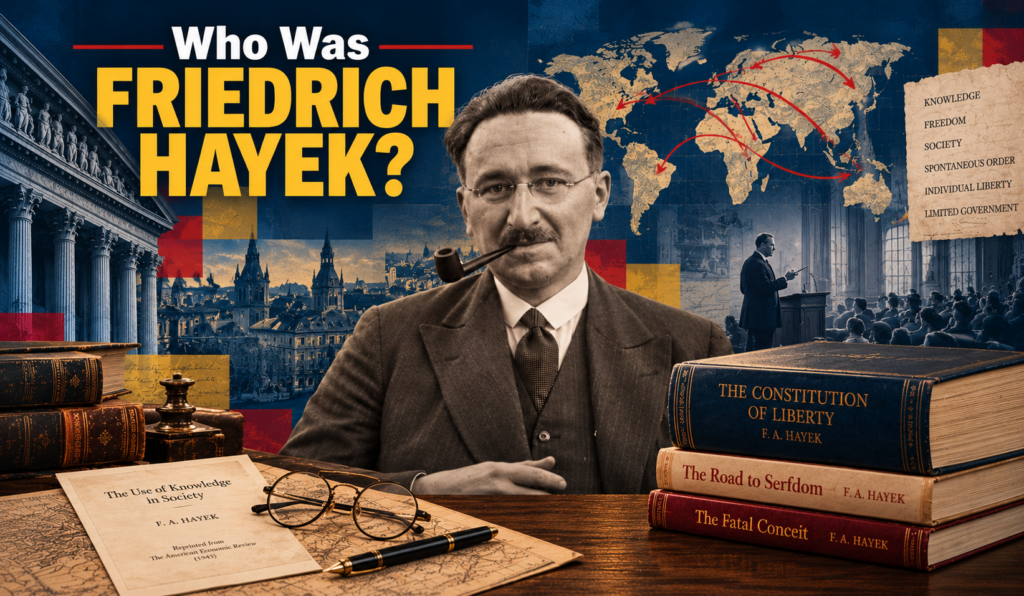
Who Was Friedrich Hayek
Written by Pete Boettke as an Institute for Liberal Studies Exclusive
There is a very basic historical answer:
- Hayek was born in Vienna on May 8, 1899
- His father was a physician and botanist, and his mother’s family also had strong scientific connections. After completing secondary school in 1917 he joined the Austro-Hungarian Army and served on the Italian front, where he was wounded and contracted malaria
- He returned to Austria in 1918 and began his studies at the University of Vienna, receiving his Doctor of Law degree in 1921, and his Doctor of Political Science/Political Economy degree in 1923
- He spent the 1923-1924 academic year in New York City, where he studied at New York University and Columbia University
- Upon returning to Austria, he would work closely with Ludwig von Mises on business cycle research and monetary policy, and in 1927 established the Austrian Institute for Business Cycle Research as the founding director
- In 1931, he would move to take a professorship at the London School of Economics, where he established himself as a leading economic theorist
- With the publication of The Road to Serfdom in 1944, he would become a famous public intellectual and social philosopher
- In 1950, he left the LSE to assume a professorship at the University of Chicago in the Committee on Social Thought
- He taught at Chicago until 1962, when he moved to the University of Freiburg, retiring in 1967, and moving to teach in Salzburg, Austria from 1969 to 1977, after which he would return to Freiburg
- Friedrich Hayek died at the age of 92 on March 23, 1992
Yet, these basic facts do not do an introduction to Hayek or his ideas justice. So, I’ll try to do that here.
Hayek’s Work
Hayek’s first published scientific works were in the 1920s. His last in the 1980s. Truly appreciating his work means exploring decades of material on many different topics, touching many different fields.
He published not only in economics, but in political science, philosophy, history, psychology, and law. He even dipped into anthropology and sociology.
His technical economics would shape modern economic theory. His most famous essay “The Use of Knowledge in Society” was selected as one of the 20 most important articles published in the first 100 years of the American Economic Review. His book The Road to Serfdom was an international best seller, while his The Constitution of Liberty would be described by Prime Minister Margaret Thatcher as The Conservative Party’s bible. He would win the Nobel Memorial Prize in Economic Sciences in 1974, but also the Presidential Medal of Freedom in the US in 1991, and was appointed a Member of the Order of the Companions of Honour by Queen Elizabeth in 1984 for “services to the study of economics.”
These accolades take us beyond a basic biography. Seeing that a little more clearly provides the context to move from Hayek’s work to Hayekian ideas.
Hayek’s Ideas
Throughout his long career Hayek had at least 4 distinct research periods.
Monetary Theory, Business Cycles, and Prices
Between the 1920s and 1940s, the main ideas were in technical economics, and in particular the coordination of economic activities through time as guided by the price system. A particular emphasis was on the role that sound monetary policy played in the coordination of exchange and production activity, or the consequences in terms of mismatched plans and discoordination due to the government manipulation of money and credit. This was in essence his pioneering theory of industrial fluctuations. Monetary theory was blended with capital theory and then fit into a price theoretic rendering of economic volatility.
Prices, to Hayek, are not summaries of past costs as some earlier economists had depicted, but prices are guides to future economic activity. They help economic actors steer the course through the fog of time and ignorance. Prices guide actors, profits lure investment, and losses discipline and redirect activity toward more valuable ventures. When government distorts the workings of prices through the manipulations of money and credit, and causes confusion in the profit-and-loss system through interventionism and fiscal imprudence, economic crises result. The “boom” is followed by the “bust” as the illusion due to easy money and fiscal irresponsibility in one period is faced with the reality of the scarcity of resources and the more accurate representation of the consumption-saving trade-off is revealed in the next period. In this regard, the economic recession is the correction to the earlier malinvestment of goods and services. Capital and labor must be reallocated to more appropriate and higher valued uses.
The Use of Knowledge and the Fatal Flaw of Central Planning
Hayek’s work on money, market and the price system proved valuable in the debate with socialist writers as well. Socialism was very popular among the intellectuals in the first decades of the 20th century, and after WWI socialist experiments started to be pursued in various European countries, and the intellectual attractiveness of a socialist alternative to capitalism only grew more pronounced after the Great Depression. Hayek, building again on Mises’s work as he had in business cycle research, started to explore the fundamental flaw with socialist planning. Private property was a necessary condition for the free exchange process that produces prices, and prices in guiding exchange and production decisions both utilize the dispersed knowledge of time and place and generates ever new and fresh knowledge in the process of higgling and bargaining.
Unfortunately, the economics profession had taken a methodological turn toward excessive aggregation in the Keynesian revolution, and an excessive formalization with the development of General Competitive Equilibrium and Neoclassical Welfare Economics. As a result, these two factors prevented modern economists from appreciating the points being stressed about prices, processes, and institutions.
A Philosophy of Science and Institutions
Rather than developing an understanding of the entrepreneurial competitive economy, students of economics were taught market failure theory and the need for government intervention to correct the failures. Confronted with this in the 1940s, Hayek developed his ideas in 2 directions in what he dubbed his “Abuse of Reason Project”: (1) philosophical foundations, and (2) institutional infrastructure for coordination of economic activity. It is important to correct a misunderstanding of Hayek’s work at that time, and since — he was not abandoning economics by taking this philosophical and institutional turn, he was seeking instead to find the right philosophical footing for economics as a science and seeking to establish in the profession the right perspective on the essential institutional framework for a functioning economy.
Economists were susceptible to aggregation and formalism because they adopted a wrong philosophy of science – one that sought to treat the social sciences as if they were natural sciences. But the central subject of social science is human actors, with their purposes and plans, with their intentions and aspirations, with their will and desires, with their beliefs and their imaginations. Nature has no equivalent animating actor. Economics is about thoughts and beliefs, not about inanimate matter.
We cannot aggregate from individual preferences to some social preference, and we cannot restrict the agony of choice where humans find themselves negotiating between alluring hopes and haunting fears to a ‘choice machine’ where the decision making can be captured in a mathematical function that has the characteristic of being smooth and continuous and twice differentiable. The argument Hayek made was that economic science must correct its current methodological and analytical course if there is to be any scientific hope for advancement of knowledge about how the economic system operates and to provide any practical guidance in the effort to repair a broken world in our political economic system.
Individualism, the Rule of Law, and Spontaneous Order
After “Technical Economics” and “The Abuse of Reason” the focus turned to a “Restatement of the Liberal Principles of Political Economy and Justice”. Ideas of constitutionally limited government. Focus on the evolution of the rule of law. The establishment of freedom of contract. Commercial life, Hayek was insisting, is always embedded with a broader ecology shaped by law, politics and social mores, customs and beliefs. The formal and informal rules of social life all became part of finding that science of economics and political economy that could be both a practical guide in reform efforts, and more importantly provide an aspirational goal of achieving a free society, a society of peace and prosperity.
For Hayek, a critical aspect in building this argument is the idea of spontaneous order. Social phenomena that are the result of human action, but not of human design. A social system where the whole is greater than the sum of its parts. Money and market prices are examples of spontaneous order. The spontaneous order of the market itself within the liberal framework of property, contract and consent would tend toward peaceful social cooperation and economic prosperity. In many ways Hayek was the 20th century restatement of the Scottish Enlightenment wisdom and insight of David Hume and Adam Smith. But his innovative approach also compelled him to explore not only the spontaneous ordering of economic activity within the appropriate institutional infrastructure, but the emergence of that institutional infrastructure itself. Law, mores and social customs are studied in Hayek as outcomes of a competitive discovery procedure in the evolution of human society from small bands to the vast expanse of the division of labor in the “Great Society” of modernity.
The Fatal Conceit
This brings us to the final intellectually radical turn Hayek took late in his career toward philosophical anthropology best illustrated in his final book The Fatal Conceit. The Hayekian argument is that there are evolutionary forces at work that apply to social rules, and these rules through a process of group selection will put pressure on the social rules that are not conducive to productive specialization and peaceful social cooperation through exchange. Exchange turns “strangers into friends” and enables human societies to escape the Malthusian trap of subsistence. But this transition did not result from the brow of a genius, or from the benevolence of Kings and Queens, but through a long and sometimes tortured process of trial and error, and competition between rule systems.
Hayek In (Proper) Summary
So, who was F. A. Hayek? Arguably the most innovative and important social theorist in the 20th century.
And, as for the 21st century, it shouldn’t go without mentioning that the scientific potential of his ideas on generative knowledge and how institutions interact to shape that generative process is arguably the most promising approach to the economics of AI and its implications for the operation of, and impact on, economic systems.
Go beyond basic bio summaries. Read Hayek. He was the greatest economist of the 20th century, and a great social thinker for the 21st century.