
250 Years of Wealth of Nations
Written by Janet Bufton as an Institute for Liberal Studies Exclusive
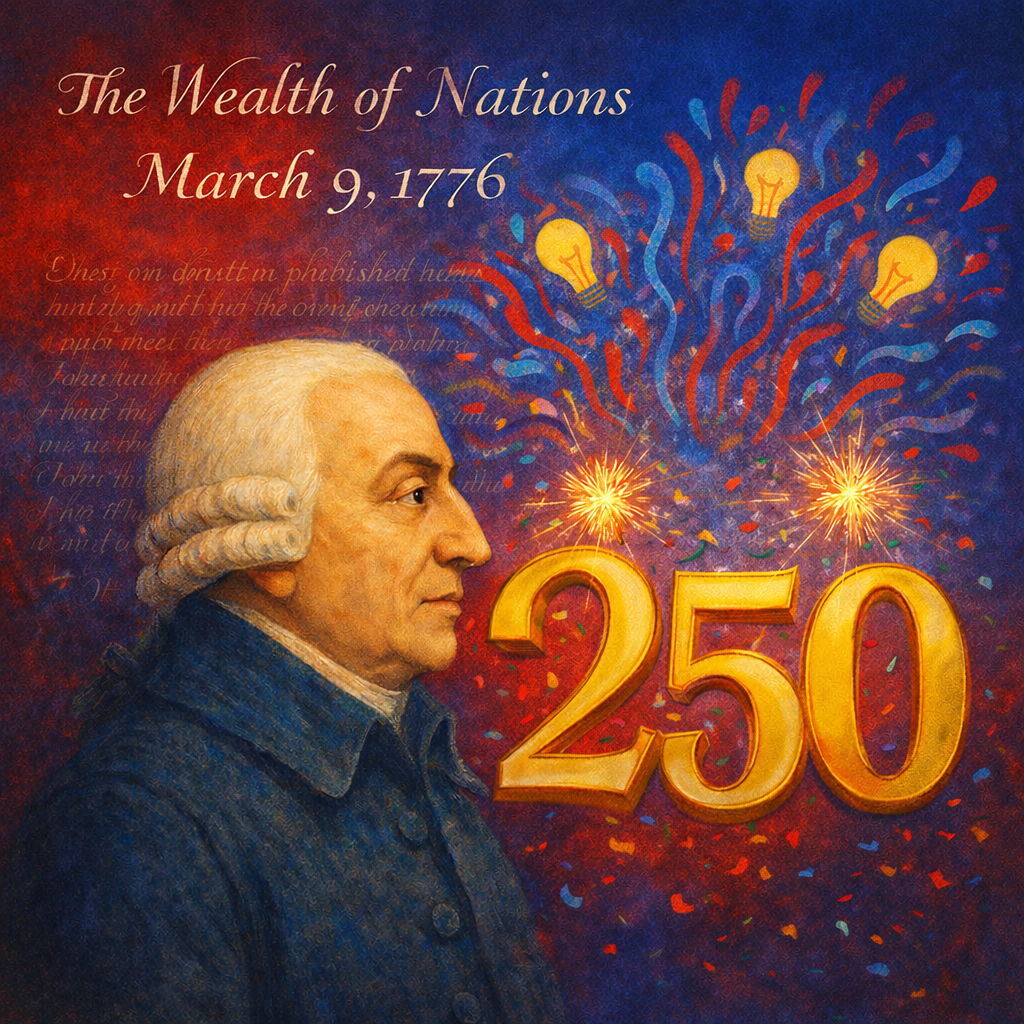
The book by Adam Smith that people are most familiar with is An Inquiry into the Nature and Causes of the Wealth of Nations, first published on 9 March 1776. In Wealth of Nations, Smith systematized what became the discipline of economics and outlined and argued for some of the principles of liberal governments and a liberal global order. It took Smith ten years to write it and it is a very long book. It is an impressively empirical work. Historical examples, tables, and statistics demonstrate the rigour of Smith’s research.
The book’s most important messages are (1) wealth is not determined by how much money a country has, but by the realized productive capacity of its people; (2) that trade and the division of labour, not the control of land and resources, are key to increasing wealth; and (3) that a government should aim to support free trade and preserve the liberty of individuals to realize their potential, rather than imposing oppressive and extractive institutions.
Smith called the argument in Wealth of Nations a “very violent attack”1 on a political-economic system he called mercantilism. Mercantilism was based on the idea that countries needed to accumulate precious metals (which were international money) through extractive empires and managed trade. Smith saw mercantilism as a chief cause of oppressive colonialism.
Smith’s economics
The Wealth of Nations is made up of five parts. The contents of Book 1 and Book 2 laid the groundwork for economics as its own field of social science. In these sections, Smith formalizes the idea of the division of labour as one way that people naturally work together. The division of labour occurs because people can get more of what they want by trading than they can on their own.
We can see Smith’s insights from The Theory of Moral Sentiments in his economics. When talking about our natural “propensity to truck, barter, and exchange” in Book 1, Chapter 2, Smith uses a now famous illustration. The butcher, the brewer, and the baker do not provide us with our dinner because they care about us, but because we “address ourselves, not to their humanity but to their self-love.” This line is often misinterpreted as an argument that people don’t care about each other, but that’s not right. Someone who wants bread but would not otherwise be able to convince a baker to give them bread can imagine what a baker wants in exchange and propose a trade. We cooperate through trade for the same reasons that we “sympathize” with each other—because we can so easily think of things from others’ points of view.
The division of labour depends on the extent of the market, or the number of people between whom we can divide up tasks. Smith’s insight about the extent of the market explains why he argues for international free trade and for public works like roads and canals. Both removing barriers to trade and making travel easier help to connect people who might trade. By trading, people split up tasks between one another and increase how much they accomplish. This is how wealth increases.
Smith’s explanation of the importance of division of labour is his most enduring contribution to economics. He also makes use of still-important arguments, such as those explaining price dynamics, laid out by David Hume. However, the specifics of Smith’s economics are undermined by his use of a labour theory of value. Though it is clear that Smith’s conception of prices (Book 1, chapters 5–7) is more complicated than a simple relationship between labour and value, the lack of a more modern understanding of value undermines many of his specific explanations of how price interacts with the factors of production (labour, land, and capital).
On the existing order (in 1776)
In Book 3 of Wealth of Nations, Smith explains his theory of how the world had grown richer. Although Smith’s economics underpin the explanation, it is surprisingly unburdened by his labour theory of value.
In Book 3, Smith emphasizes what he thinks is one of David Hume’s most important insights: that through economic growth “commerce and manufactures gradually introduced order and good government, and with them, the liberty and security of individuals, among the inhabitants of the country, who had before lived almost in a continual state of war with their neighbours, and of service dependency upon their superiors.” (Book 3, Chapter 4) This is an empirical observation that resulted from the fact that a certain amount of trust, predictability, legal egalitarianism, and peace is required for commercial life.
The observation about introducing order, good government, and peace does not rely on implementing a completely free market, and should not be expected to drive society towards a completely free market, because he is describing the history that led not to mercantilism, not to free markets and free trade.
In Book 4, Smith describes the system he is arguing against: the mercantile system. He believes that mercantilism is based on a mistaken economic premise, which explains why mercantile governments undermine economic growth and individual liberty. Book 4, Chapter 2 contains Smith’s reference to the “invisible hand,” which he uses as a metaphor for the patterns of behaviour that result from the incentives of market activity that he explored in Book 1. In brief, when we address ourselves to one another’s self-interest and are allowed to cooperate through the market, we are better at providing for one another’s needs and wants than if we tried to directly provide what we wanted at a societal level.
A recurring theme in Book 4 is Smith’s condemnation of “monopolies”. Although some of his criticisms of monopolies are the same as modern criticisms—lack of competition means worse goods at worse prices—Smith is talking about something else. In Smith’s time, “monopolies” were exclusive privileges granted by the government to corporations, like the Hudson’s Bay Company and the East India Company, to control not only economic resources but often also the governance of land and peoples. This is why those corporations were tied to both mercantilism and colonies.
Monopolies in Smith’s time were symptoms of what Douglass North, John Wallis, and Barry Weingast would (two centuries later) call a “limited access order”, which rested on special privileges granted by a small number of powerful people. This is in contrast to the later, liberal “open access order” that allows equal access to legal mechanisms to form corporations.2 Some readers see contemporary observations in Smith’s condemnation of corporations, but we can’t know what Smith would have thought of today’s corporations because they are the product of a fundamentally different system.
Smith’s political theory
Adam Smith had hoped to write a third book on “jurisprudence,” which we would call law, politics, and government. But he did not finish it and had his manuscripts burned before his death. While some of his students’ lecture notes from when Smith taught early in his life about jurisprudence survive, Book 5 of Wealth of Nations, added in a later edition of the book, is likely the best version of Smith’s thoughts on government in his own writing.
Book 5 has three chapters. Nominally, the first is on what governments should do, the second is on how governments should raise revenue (mostly through taxation), and the third is on government debts.
Chapter 1, on the “Expences of the Sovereign or Commonwealth”, is the most commonly read chapter in this book. Smith argues that the duties of a government are providing peace and security through national defence and a justice system; providing public works to support commerce; ensuring that people are educated, both as children and on an ongoing basis; and supporting the dignity of the sovereign.
Smith argues for the benefit of a standing army (necessitated by the division of labour in a sufficiently rich society) and how the previous provision of the justice system through fee-for-service can inform thinking about the more familiar (in his time) state provision of justice.
Smith’s discussion of education has been of particular interest to classical liberals. Smith argues that governments should ensure that all children receive a basic education in literacy and arithmetic. He sings the praises of Scottish parish schools like the one where he was educated. Smith also argues that teachers are most likely to provide a useful education when they are paid by students directly, rather than through a salary from the school.
The argument that teachers should be paid directly by students is appealing to advocates of more private provision of education or school voucher programs. Some even argue that when Smith makes education one of the “expences” of the government, he is not arguing that the government should spend public money on education. However, this section is also used by advocates of public education systems as evidence that even a classically liberal government should make a good education system a key budget item.
Additionally, we might worry about what Smith means by “useful” when reading his opinion of women’s education. Smith praises the standard education of women in his time because it is free of the “useless, absurd, or fantastical” since it only teaches the practical matters of household management and child-raising. Today, liberals agree that women benefit from a fuller education that they choose for themselves when given the option.
Less widely read is Smith’s discussion of the education of people of all ages—by which he means the government’s role in the religious education of its citizens, especially where there is an established (state-sponsored) church, like the Anglican or Presbyterian church. This section discusses the role of private association rights, institutional competition, and the development (and containment) of political factions—all important themes for liberal political theory.
We might also wonder whether Smith was sincerely interested not in religion, but in “institutions for the instruction of people of all ages” (the name of the section). If the focus is on ongoing civic education, Smith may be arguing that the government should be responsible for institutions that provide accurate public information, making the focus on religion an incidental one.
Finally, Smith believed that some public spending on the trappings of power was justified. This is likely because he believed that people tend to defer to visible power. If this deference could be encouraged with pomp and circumstance around the head of state, less force might be required to run the government.
More than money
The final two chapters of Wealth of Nations are on the surface about funding the government, but they cover much more than that.
Smith discusses public revenue, including revenue-generating public services, like banks or postal services, revenues from public land, and taxation. He covers the way that people adjust their behaviour based on the taxation system, the incentives created by different forms and targets of taxation, and the importance of considering whether taxes fall most heavily on the least well-off. Smith also uses analyses reminiscent of public choice to examine why taxes so often fall on the least well off and spare the rich and powerful, and talks about how popular prejudices can influence tax systems.
The last chapter of Wealth of Nations, on public debts, is under-read and underrated. Smith discusses the incentive problems facing governments’ management of public finances. His insights about taxation and debt often feel contemporary.
The last part of this chapter also ties the book together. Smith explains why even a benevolent and well-managed country should not rule over others without representation, even when that rule has resulted in material prosperity. He argues that Black slaves, however well-provisioned, are still worse off than the very poorest free person. This description of the importance of individual freedom explains why enslaved people were willing to fight and die to gain their freedom. This put Smith in opposition with those in favour of slavery who argued that enslaved people were better off than free Black people.
Smith wrote Wealth of Nations in the decade before the American Revolution. It was published just four months before July 4th, 1776). In the conclusion of the book, he takes a stand: even if we accept that an empire can be ruled by a just and prudent country, its colonies should be allowed to participate equally in their governance, required to fund themselves through taxation and revenue, and treated as equal trading partners.
Smith starts with an insight about social cooperation under market institutions and ends by arguing for the importance of the freedom and dignity of people who use those institutions. Failure to respect the importance of individuals encourages institutions that undermine both people and wealth. Smith’s insights point toward a wealthier, freer, and more equal world.
For a long time, many took Smith’s advice, but today many disagree, especially about free trade. We should keep reading Adam Smith because his arguments worked before, and we will always need arguments that can stand for liberalism.
Read more:
The full text of An Inquiry into the Nature and Causes of the Wealth of Nations is available free online at the Online Library of Liberty.
126 October 1780, Letter from Adam Smith to Andreas Holt
2See also Jacob T. Levy, Political Libertarianism.