
Who Was Adam Smith?
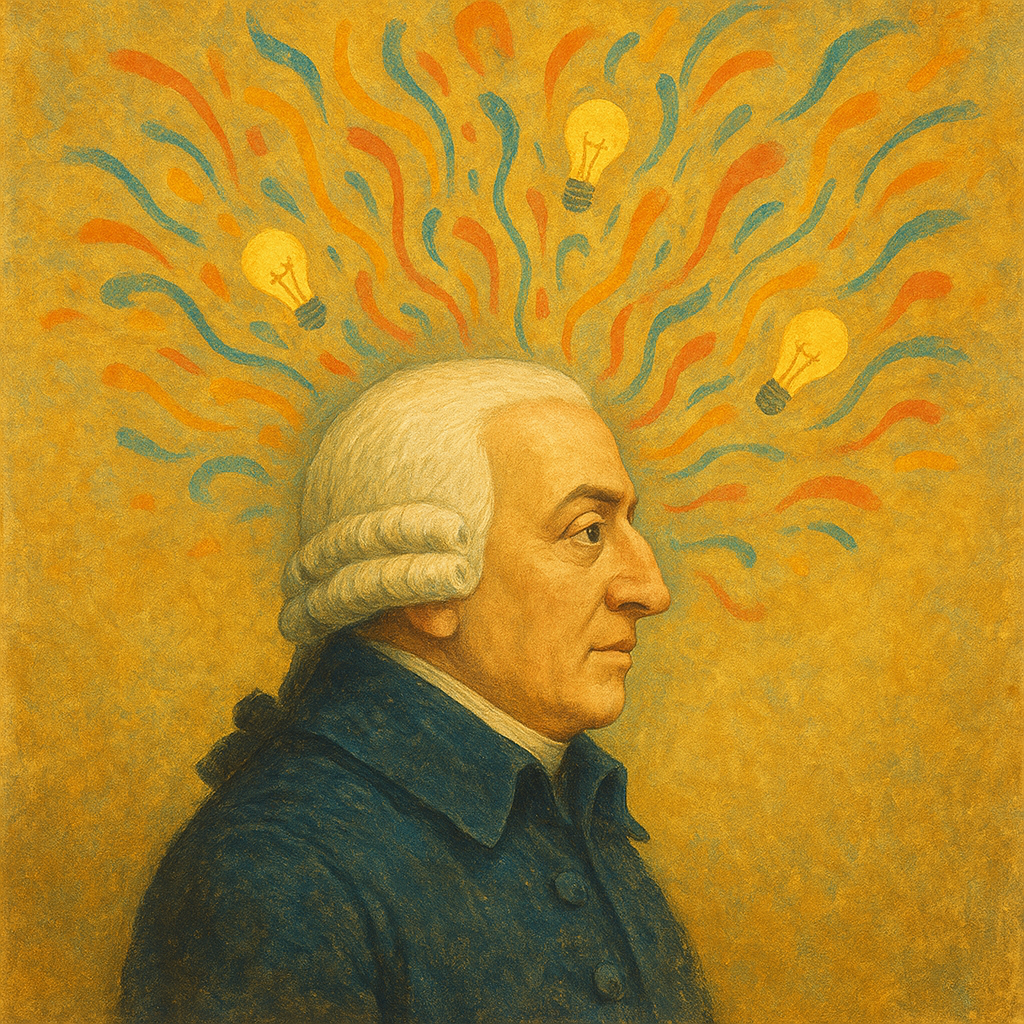
Written by Janet Bufton as an Institute for Liberal Studies Exclusive
Adam Smith (1723–1790) was a Scottish moral and political philosopher who you’ve probably heard about because he is responsible for the metaphor of the invisible hand, because he is “the Father of Economics,” and because of his most famous book, An Inquiry into the Nature and Causes of the Wealth of Nations (1776).
Smith was a philosopher in part because economics hadn’t yet been become its own field of study, but also because much of his work was not about economics. His first work, The Theory of Moral Sentiments (1759), was a book about moral philosophy, and it’s actually the one that made him famous. Wealth of Nations was really about political economy more broadly. Before either book was published, his lectures on rhetoric were hugely popular with students and contemporary thinkers.
Social learning
Adam Smith believed that we learn morality from one another and that it is formed by our interactions. In one of his essays, On the External Senses, he describes how a baby learns about the physical aspects of the world through experience: feeling and pushing against things they can see, and using their senses to smell, hear, and taste new things. Once babies develop basic mental rules about how the physical world works, their brains are freed to learn more complex ideas.
Experiential learning also explains how Smith thinks we learn and create moral rules. Smith believes that people have a moral sense, but disagrees with his teacher, Francis Hutcheson, that we’re born with this sense. Instead, Adam Smith and his mentor and friend David Hume believed that morality is learned through repeated social experiences. Smith argues that we naturally imagine what it would be like to be other people. He believed we learn as part of our social development, and what we feel in reaction to and on behalf of each other helps us understand what rules are good or bad.
Smith uses the term sympathy to describe a feeling that people naturally have towards each other. We feel on behalf of one another based on what we do or they do, on the reactions of those observing us, and on the moral rules we learn by doing this. Because we are both learning and creating moral rules, the enforcement of those rules matters. If the rules are bad (immoral institutions), or they are broken or not enforced (immoral people), both personal and social morality can be corrupted.
Smith also advocates the cultivation of our ability to imagine what an impartial spectator, someone who isn’t biased by our strong personal feelings, would think. We should take the reaction of this imagined person into account when judging how we should act (or react).
The Wealth of Nations
Smith’s best known book today is Wealth of Nations. The book’s most important messages are (1) wealth is not determined by how much money a country has, but by the realized productive capacity of its people; (2) that trade and the division of labour, not the control of land and resources, are key to increasing wealth; and (3) that a government should aim to support free trade and preserve the liberty of individuals to realize their potential, rather than imposing oppressive and extractive institutions.
The misconception that a nation’s wealth was simply about the money it held was, in Smith’s mind, responsible for a political order that prevented people from cooperating peacefully and becoming richer, especially in the case of oppressive governance in colonies and missed opportunities for peaceful commercial relationships between countries.
Smith also developed important parts of modern-day economics in Wealth of Nations. One example is that he systematized our understanding of the division of labour as one way that people naturally work together.
We can see Smith’s insights from The Theory of Moral Sentiments in his economics. When talking about our natural “propensity to truck, barter, and exchange” in Book 1, Chapter 2, Smith uses a now famous illustration. The butcher, the brewer, and the baker do not provide us with our dinner because they care about us, but because we “address ourselves, not to their humanity but to their self-love.” This line is often misinterpreted as an argument that people don’t care about each other, but that’s not right. Someone who wants bread but would not otherwise be able to convince a baker to give them bread can imagine what a baker wants in exchange and propose a trade. We find ways to cooperate through trade for the same reasons that we “sympathize” with each other—because we can so easily think of things from others’ points of view.
Smith observes that the division of labour is limited by the extent of the market, which explains why he argues for international free trade and for public works like roads and canals. Both removing barriers to trade and making travel easier help to connect people who might trade. By trading, people split up tasks between one another and increase how much they accomplish. This is how wealth increases: more people, more cooperation, and more wealth.
Wealth of Nations also presents Smith’s political theory, in what may be an early version of a never completed book about politics and law. (See 250 Years of Wealth of Nations for more discussion of Smith’s political theory.)
The Invisible Hand
Although Adam Smith’s most famous phrase is “invisible hand”, he only uses it three times across all of his works, and only twice to describe people acting together in market transactions. (The third instance describes the patterns created by gravity in space, in his early essay on “The History of Astronomy”.)
Smith first introduces the invisible hand in an economic sense in Part 4 of The Theory of Moral Sentiments, in a discussion of the ways luxury goods are economically useful. Smith says that when rich people spend their money on commercially produced goods (rather than simply holding onto money to pay for wars or to spend on supporting dependent servants and peasants), the money circulates in the economy, supporting many more workers.
Smith does not use the invisible hand to talk about the production of a specific good, but he does use the example of a woollen coat that “is the produce of the joint labour of a great multitude of workmen.” Coat production in a money economy means that purchasing a single coat supports the work of shepherds, wool sorters, wool-carders, dyers, scribblers, spinners, and weavers—to name only some of those who contribute to the coat before the cloth is even produced.
Smith claims in Moral Sentiments that by spending their money in commercial society, rich people “are led by an invisible hand to make nearly the same distribution of the necessaries of life which would have been made had the earth been divided into equal portions among all its inhabitants” (Part 4, Chapter 1). This is an exaggeration, but spending money in markets rather than only within private households did have a levelling effect on both wealth and social standing.
The more famous use of the “invisible hand” appears in Book 4 of Wealth of Nations as part of Smith’s argument for free trade. In this case, Smith explains how the most productive economic investment and production patterns can result from the incentives of market activity that he explored in Book 1. Namely, when we address ourselves to the self-interest of others and are allowed to cooperate through the market, the resulting economic arrangements are better at providing for one another’s needs and wants than anyone trying to act on a whole country’s behalf.
Smith’s proto-liberalism
Adam Smith lived too early to be a fully-formed liberal, but he was an important thinker about many of the principles that underpinned the liberalism of later thinkers, especially Benjamin Constant, the first modern liberal.
Smith was a radical moral egalitarian, arguing in his Moral Sentiments that babies are completely equal when they are born, and that differences between a philosopher (academic) and a street porter (delivery person) only develop through different life experiences. People have different life experiences because of luck and things like the social patterns created by the division of labour.
Smith was also a strong opponent of slavery, arguing not only that it was economically wasteful, but morally repugnant—being a richly appointed slave, he claimed, was worse than being so poor that most of your children don’t survive.
Smith believed equality had to be argued for (after all, he did so), and that society would not naturally tend towards egalitarianism because people naturally enjoy dominating one another, and Smithian sympathy encourages more consideration and accommodation of the great and powerful than the poor and needy.
Smith also provided explanations for how people develop norms and rules peacefully, without an overarching plan or power. Norms and rules can result in orderly patterns no one was aiming for: people are “guided by an invisible hand.” He also explained how social institutions, especially market institutions, often provide better results than top-down order. Smith’s explanations rested on understanding people as social individuals who can motivate one another to cooperate when there is not enough goodwill, public spiritedness, or charity.
But Smith also talked about coordinated action that might be backed by power. In his political theory, he argues for governments that encourage both the peace and security of individuals and the institutions to support commercial society and encourage cooperation.
Smith believed that aiming directly at national wealth led to injustices ranging from unnecessary force against individuals to the oppression of entire peoples through colonialism and slavery. In making the wealth and well-being of individuals the focus of his inquiry into the wealth of nations, Smith argued that it is a mistake to aim for national wealth and power directly. Rather, he argued that more wealth is produced by a nation’s people working to improve their own well-being.
Smith’s belief in the importance of free and equal individuals, and their propensity to cooperate given the right institutions, is evident throughout his work. For a long time, many took Smith’s advice, but today many disagree, especially about free trade. We should keep reading Adam Smith because his arguments worked before, and we will always need arguments that can stand for liberalism.
Read more:
The works of Adam Smith are available free online at the Online Library of Liberty.