What Is Public Choice?
Written by Michael Munger as an Institute for Liberal Studies Exclusive
If you’ve ever muttered that a piece of legislation “makes no sense,” and surely no rational person could have written it, you have posed the central puzzle of Public Choice. What if politicians, bureaucrats, and voters are not different in motivation from consumers and self-interested corporate actors? What if nonsensical laws are actually “rational,” from the perspective of those self-interested government actors?
The answers to those questions are actually obvious. But for much of the twentieth century, economists and political scientists analyzed markets by assuming self-interested consumers and firms, while treating government as a separate creature entirely — a unified, benevolent problem-solver waiting to step in whenever markets fell short. Spot a “market failure,” and the textbook prescribed a fix: have “the government” correct it. The origins of Public Choice import James Madison’s famous insight that people are not angels, and they are not led by angels. From that foundation, Public Choice creates a means of understanding how real people act in real situations, rather than imagining unicorns actually live and breathe in the halls of world capitols.
Two Economists, One Insight
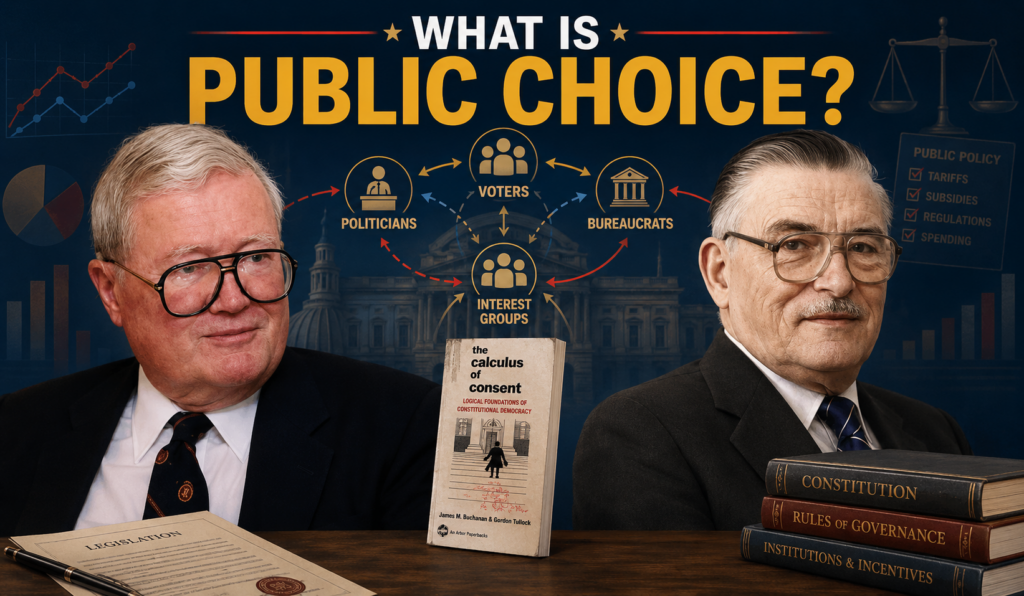
The field’s founders were James Buchanan and Gordon Tullock, whose 1962 book The Calculus of Consent laid its foundations. Buchanan would go on to win the 1986 Nobel Prize in economics for the work; commentators at the time joked that his central insight was homely, even obvious: politicians, it turns out, are no different than the rest of us.
That claim is true, but it’s wrong to dismiss Public Choice as a cynical theory of corruption, or politics gone wrong. Instead, something more disciplined is being claimed: whatever model of human motivation explains behavior in markets — mixed, self-interested, sometimes generous — must also explain behavior in legislatures, agencies, and voting booths. Economists call this behavioral symmetry. A shopper does not become an angel entering the ballot box, and a regulator does not become omniscient by being appointed to a commission.
Rules, Not Just Motives
If Public Choice stopped there, it would be little more than cynicism dressed up in economics jargon. What makes it a genuine theory is its attention to rules. Buchanan insisted that outcomes — good or bad — are produced not by the goodness or badness of the people involved, but by the incentives and information that different institutional rules create. Change the voting rule, the committee structure, or the property-rights regime, and you change what the same people, with the same motives, will choose to do.
This is why Public Choice always insists on methodological individualism: explanations must trace outcomes back to the choices of actual people, not to a fictional actor called “the government” or “society.” When we say “the government decided to raise tariffs,” we are skipping the real explanation — which legislators proposed it, which industries lobbied for it, and which voters were too busy, or too rationally uninterested, to organize against it.
That last point matters enormously. A small, organized industry can win a subsidy or a tariff because its members have every incentive to lobby hard for a concentrated benefit, while the cost is spread so thinly across millions of consumers that none of them find it worth the bother to fight back. This is not a story about villains. It is a story about the costs of organizing, and it explains an enormous share of what looks, from the outside, like “irrational” policy.
Politics as Exchange — and Its Limits
The most hopeful, and most neglected, part of Buchanan’s vision is the idea of politics as exchange. Ordinary political bargaining — vote trading, logrolling, coalition-building — resembles a marketplace, but one where “gains from trade” are just as often gains for the well-organized at the expense of everyone else. At the constitutional level, though, something different is possible: people can agree in advance on rules — including rules that will later require coercion — because they can see, without knowing their own future position, that the rules serve everyone’s interest. That kind of agreement, not a claim that politicians are saints, is what can justify government power at all.
Public Choice also insists that the boundary between “ours” (state) and “mine” (private, voluntary) is not fixed. What counts as a genuine public good — hard for markets to provide because it is costly to charge for and impossible to ration — shifts as technology changes. Toll roads once needed clunky booths and long lines; electronic transponders now make congestion pricing nearly costless, turning what was once treated as a natural state function into something markets and voluntary associations can often handle instead. Sweden and Finland, for instance, have run tens of thousands of private road associations for generations. The lesson isn’t that government is never needed — it’s that its proper scope is a standing question, not a settled one.
Politics With Optimism, But No Romance
Public Choice is sometimes dismissed as a purely cynical discipline — a permanent argument that government fails. That’s a half-truth. Its real ambition is more constructive: to ask what rules allow self-interested, imperfectly informed people to cooperate for mutual benefit, whether in markets or in politics. For anyone who cares about liberty, using a more realistic model of political life is not cynicism, but progress. As Public Choice scholars have shown, there is no other way to explain actual government policies, and the actions of real human government actors.