
Who Was Jane Jacobs?
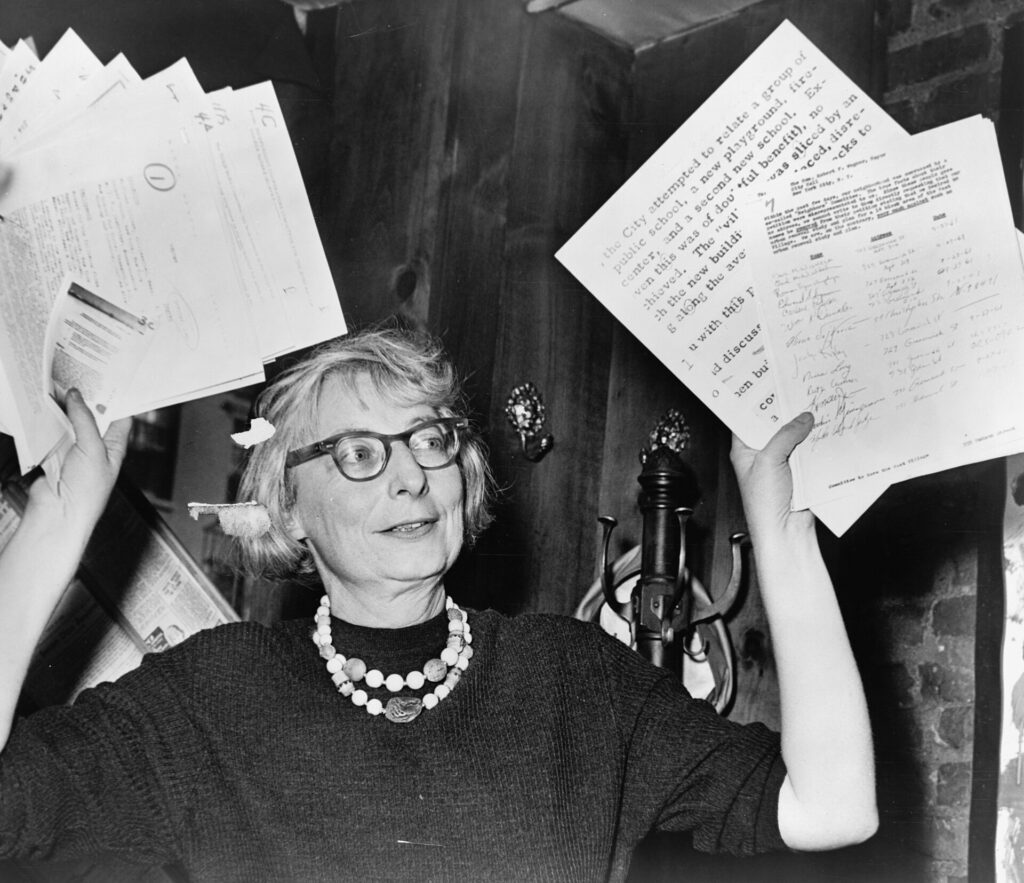
Written by Sanford Ikeda as an Institute for Liberal Studies Exclusive
Jane Jacobs (1916-2006) is perhaps the most celebrated and influential urbanist of the 20th century, and her ideas continue to be regularly cited in the popular press and in academic publications.
If you’ve seen the movie Motherless Brooklyn, the cable series Marvelous Mrs. Maisel, or the play Straight Line Crazy, you will have encountered her character or her analogue in a central role. She was also the subject of a full-length documentary, Citizen Jane, in 2016.
Jacobs is typically remembered and portrayed as a smart, fierce, and tireless activist, and justifiably so. She fought against the planning powers-that-be to save local communities from rapacious developers and ruthless urban planners, whilestressing the importance of the urban vitality of walkability, density, and street life.
She authored several path-breaking books, the most popular by far being The Death and Life of Great American Cities (1961) where she presents a rigorous and devastating argument against heavy handed, top-down urban designs. Instead, she favors policies that enable people to harness their resourcefulness and “local knowledge” to solve problems such as safety and land use where they live and work.
Phrases from that book, like “the sidewalk ballet” and “eyes on the street,” have become part of today’s urban vocabulary. But her other books are also wellworth reading and studying—notably The Economy of Cities (1969), Cities and the Wealth of Nations (1984), Systems of Survival (1992), and The Nature of Economies (2000). She also published an essay on Quebec separatism, The Question of Separatism (1980), after becoming a Canadian citizen.
Jacobs continues to inspire urbanist activists, but influential academics have also cited her work, including Nobel-Prize winning economists F.A. Hayek and Robert Lucas, and Alain Bertaud—formerly the principal urban planner for the World Bank.
An activist, urbanist, economist, and social theorist. Not bad for someone without a college degree!
Activist
Jacobs is best known as a relentless opponent of New York City’s head of urban planning Robert Moses, whom historian Robert Caro famously dubbed “The Master Builder.” For instance, Jacobs organized opposition to a planned extension of 5thAvenue through the heart of Greenwich Village, that forced the imperious Moses to back down. Later, Jacobs spearheaded a campaign to oppose Moses’ plan to cut a superhighway through Lower Manhattan, as he had done in the Bronx. And when she and her family moved to Toronto in the 1960s, she fought the construction of the Spadina Expressway.
But she did not simply protest and oppose.
In The Death and Life of Great American Cities, for example, Jacobs describes in detail what planners of her day didn’t appreciate about the complexity and spontaneity of cities, to the detriment of urban vitality. She lays out a principled, observation-based analysis of the nature and significance of the city. Her later writings extend this analysis to the global economy.
Urbanist
Death and Life focuses on how the built environment influences the social order; on land-use diversity, safety, walkability, community networks, and the way these interact. It explains the conditions under which these spontaneously emerge and the limits of what planners can do to foster them.
For example, instead of increased spending on formal surveillance to improve the safety of public spaces, which is the foundation for economic and social vitality, Jacobs advises giving people an incentive to occupy those spaces at different times of the day. She observes that “people attract people,” and so the presence of others in public spaces, even strangers, serves two safety functions. First, it tends to make us feel safer. Second, troublemakers tend to shy away from places where there are plenty of “eyes on the street.” Policing may be necessary in certain circumstances, but most public civility takes place in this way without formal intervention.
One thing that works against this is isolating different land uses in different parts of the city, i.e. so-called “functional zoning.” Instead of a neighborhood that mixes together housing, office and commercial space, entertainment, or light manufacturing (we once lived on a nice residential street in Astoria Queens that had a guitar-string factory at one end), American urban planners, beginning early in the 20th century, viewed the growing dynamic spontaneity of cities as chaotic and thought functional zoning was the solution. Jacobs points out that mixing such “primary uses”—i.e. uses that attract outsiders into a neighborhood or district—is essential for bringing people out into public space throughout the day. In combination with high concentrations of people residing, working, or playing in the area, along with walkable blocks and the availability of some reasonably priced working and living spaces (naturally provided by old, worn-down buildings), such a mixture of primary uses give rise to a constant flow people who contribute those “eyes on the street” and informal monitoring of safety. The result is that “sidewalk ballet” characteristic of livable and living cities.
Economist
While rightly lauded for her activism and urbanism, Jacobs herself considers her most important contributions to the world of ideas are in economics, especially the theory of economic development. She is explicit about this in the introduction to Death and Life (p.14), and develops her ideas in her subsequent books. Few, however, among even her ardent admirers seem to have appreciated this, and most economists, with the prominent exceptions noted earlier, have ignored her insights.
Largely, this is because, besides being uncredentialed, she views cities as messy laboratories of experimentation, where people try and fail to discover and exploit opportunities, and expresses her theories in words rather than mathematics, contrary to the desideratum of mainstream economics for elegant, equilibrium-based mathematical models. For Jacobs, untidy but effective economic development is what living cities excel at, and in such an environment the concepts of efficiency and optimality, the pole stars of modern economic theory, have little value. In this way, Jane Jacobs’s economics is far closer to Adam Smith than mainstream economics.
For Jacobs, cities, unlike nation-states, are natural units of economic analysis, and they are the prime locus of innovation—in fact, that’s the way she defines a city. But for a city to consistently generate innovations and develop economically, its inhabitants need to trade with people in other cities. She posits that the genesis of a settlement that becomes a city is the gathering of strangers who would otherwise shun one another, attracted by the opportunities to trade in their diverseknowledge, skills, and tastes. In this scenario, imports into the settlement are paid for by exports to other places. The process whereby locals create replacements for some imports increases the complexity of the local division of labor and enables them to shift their purchases to different imports. These and other locally produced goods become exports, thus fueling an expanding import-export cycle.
In this way, Jacobs’s economics is closely tied to her urbanism. These in turn are underpinned by her social theory.
Social Theorist
There are two aspects to Jacobs’ social theory.
The first, complexity, is something she writes about explicitly in the final chapter of Death and Life, in which she explains how a city with its multiple interacting factors is different from either a mathematical function or a random process, and why this means a living city is too complex to design. It’s more like a living organism than a machine.
The second aspect is that this complexity emerges largely unplanned, like the way informal contact among strangers can generate new cuisines or novel technologies. F.A. Hayek has termed this phenomenon a “spontaneous order.” While mostly implicit in Jacobs’s work, she discusses this explicitly in the first chapter of The Economy of Cities. A living city evolves unpredictably over time, and while urban planning has a role, it is limited to creating the conditions for ordinary people to peacefully interact and create as they see fit. The complexity of a city is something you can partially plan for but not design.
Jacobs is also a pioneer in ideas later social theorists have picked up on, namely, trust, social capital, and social networks. These ease the making and breaking of the contacts and allow us to discover and share new opportunities and ideas.
Classical Liberal?
If you think all this makes Jane Jacobs sound like a classical liberal, you would only be partly right. Throughout her career Jacobs staunchly shunned ideological labels, and instead called herself a “pragmatist.” Still, she had an unmistakable appreciation for and understanding of markets and the resourcefulness of free individuals, though she occasionally advocated limited government intervention where she believed it necessary. Nevertheless, those interested in exploring the ideas of freedom and the classical liberal tradition can learn a great deal from Jacobs—especially about social orders and how markets and cities operate from the ground (or street) up.